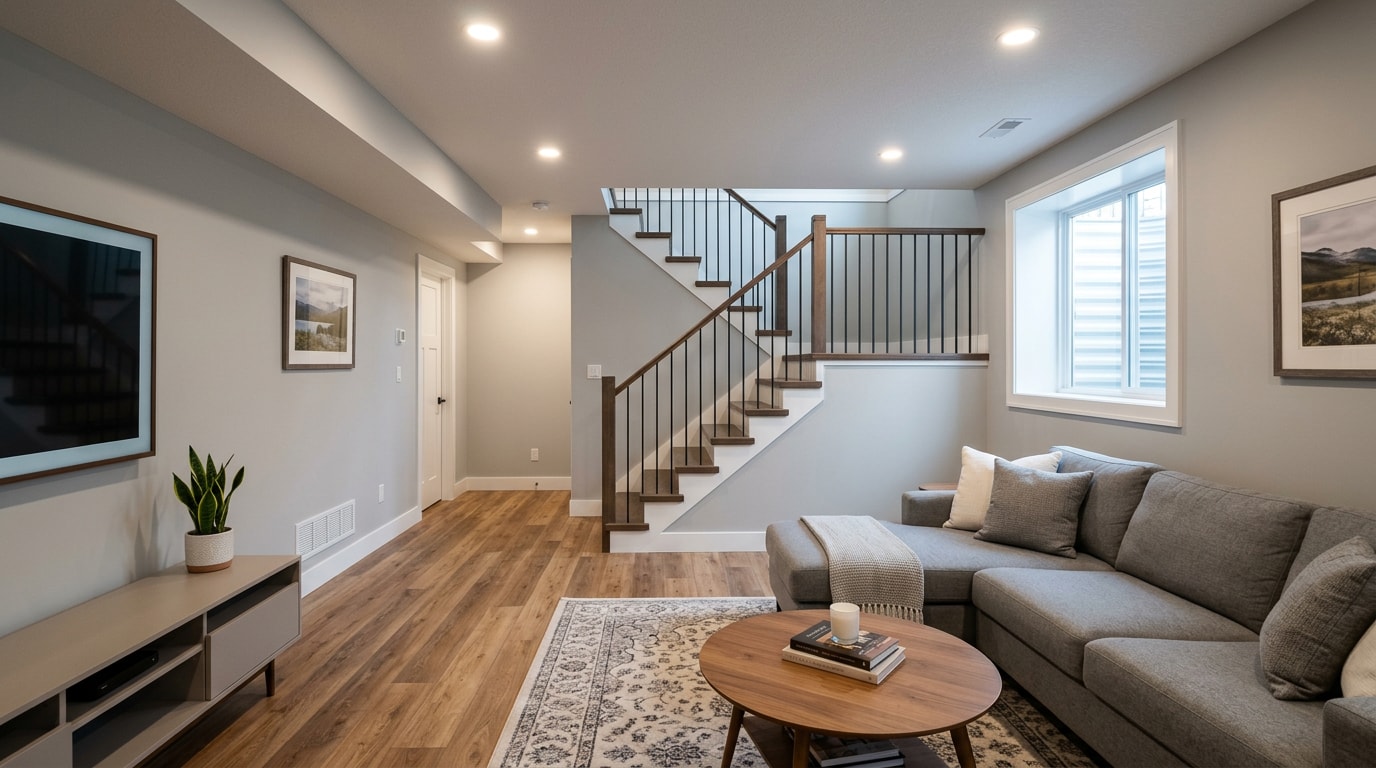
How much to finish a basement in 2026 depends on one factor more than square footage: what level of finish you're actually buying. A basic rec room with carpet and a drop ceiling costs a fraction of a contractor-built suite with a full bathroom, egress window, and custom millwork. This guide breaks down real 2026 pricing by size, task, and location, plus the line item most homeowners forget to budget until it stalls their permit.
How Much Does It Cost to Finish a Basement in 2026?
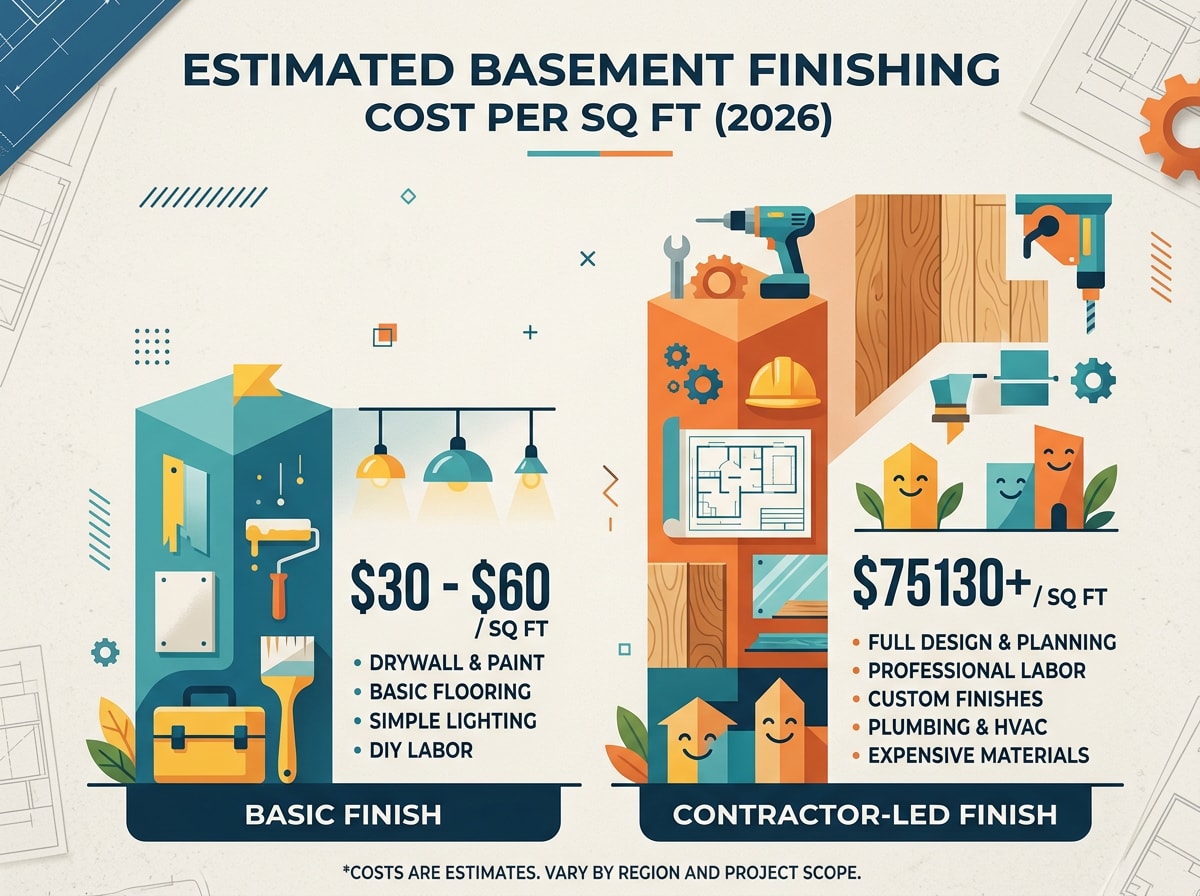
Most basement finishing projects in 2026 run $15,000 to $75,000, with a national average around $32,000. On a per-square-foot basis, expect $15 to $30 for a basic finish, $30 to $75 for a standard contractor-led finish, and $75 to $120+ for a high-end space with a full bathroom, wet bar, or home theater.
If you've seen the older figure of $7 to $23 per square foot floating around other cost guides, treat it with caution. That range reflects pre-inflation pricing and basic-only scopes. Framing lumber, licensed-trade labor, and permit fees have all pushed standard contractor-led work well past that number in most 2026 markets, sometimes by double.
A basic finish typically includes drywall, paint, carpet or vinyl flooring, and a drop ceiling. A standard contractor-led finish adds full framing, code-compliant electrical, HVAC extension, and often a bathroom. That gap, not square footage alone, is why two basements the same size can land $40,000 apart.
Basement Finishing Cost by Size
Square footage sets your baseline budget, but the finish level you choose multiplies it. Here's how total cost breaks down across common basement sizes at both tiers.
| Basement Size | Basic Finish | Standard Contractor Finish |
|---|---|---|
| 500 sq ft | $7,500 – $15,000 | $15,000 – $37,500 |
| 800 sq ft | $12,000 – $24,000 | $24,000 – $60,000 |
| 1,000 sq ft | $15,000 – $30,000 | $30,000 – $75,000 |
| 1,500 sq ft | $22,500 – $45,000 | $45,000 – $112,500 |
| 2,000 sq ft | $30,000 – $60,000 | $60,000 – $150,000 |
A 1,000 sq ft basement is the most-searched benchmark size, and it shows the spread clearly: $15,000 on the low end versus $75,000 for a full contractor finish on the exact same footprint. Add a full bathroom or push into high-end finishes, and that same space can clear $100,000.
For comparison, finishing existing basement square footage still runs far cheaper per square foot than building new space above grade. If you're weighing a basement finish against a ground-level addition, our guide to residential addition contractors breaks down how those two project types compare on cost and timeline.
Basement Finishing Cost by Task
A task-by-task breakdown shows where the money actually goes instead of one vague lump sum. Framing, flooring, and electrical are typically the three largest line items.
Framing: Basement framing runs roughly $7 to $20 per square foot for labor and lumber, not including insulation or drywall. Costs climb when a basement has support columns, low ceilings, or ductwork that needs to be boxed in around new walls.
Flooring: Installed basement flooring generally costs $2 to $15 per square foot depending on material. Carpet sits at the low end, luxury vinyl plank and laminate in the middle, and tile or engineered hardwood at the top. Because basements sit below grade, flooring almost always needs a vapor barrier or moisture-resistant subfloor first, which adds to the total. Our flooring installation team can walk you through which product fits a below-grade install before you buy materials.
Electrical: A standard basement electrical package runs $1,000 to $5,000, covering new circuits, outlets, lighting, and a dedicated circuit for a bathroom or wet bar if one is added. Electrical work must be performed by a licensed electrician in nearly every jurisdiction, both for safety and to pass inspection.
Bathroom addition: Adding a half bath typically adds $8,000 to $18,000; a full bath with a shower runs $15,000 to $35,000, depending on whether an ejector pump is needed for below-grade plumbing. If a basement bathroom is part of your plan, our bathroom remodeling team can scope the plumbing rough-in alongside the rest of the finish.
What Affects the Cost to Finish a Basement
Starting Condition
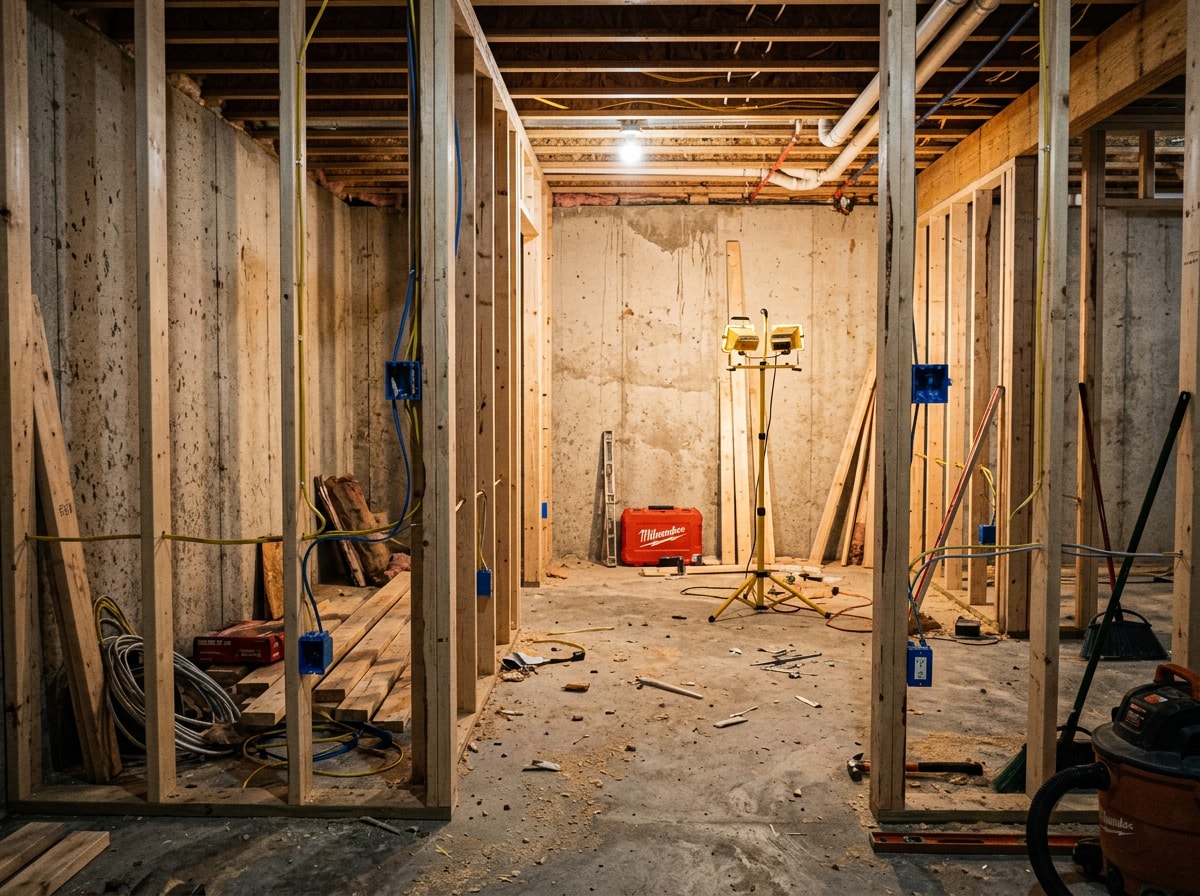
An unfinished basement costs the most to convert because everything, walls, flooring, wiring, and often plumbing, has to be built from scratch. A partially finished basement, where some framing or flooring already exists, usually costs less because a contractor can build on what's there rather than starting over.
Permits and Egress
Nearly every municipality requires a permit before basement work begins, and combined building, electrical, and plumbing permit fees typically run $200 to $2,500 depending on scope and location. Skipping this step risks fines, forced teardown of completed work, and complications at resale.
If you're turning any basement room into a bedroom, code requires an emergency escape and rescue opening, better known as an egress window. The International Residential Code sets this as a non-negotiable minimum: <a> emergency escape and rescue openings must have a net clear opening of not less than 5.7 square feet</a>, with a sill height no higher than 44 inches from the finished floor. Cutting a new opening into the foundation, installing the well, and waterproofing it is its own line item, often several thousand dollars, and it's the single most common reason a basement budget runs over.
Here's a direct link to that code section if you want to check it yourself: IRC Chapter 3, Section R310.
Moisture and Radon
Before any drywall goes up, the space needs to be dry and tested. Radon is colorless and odorless, so testing is the only way to know if it's present. The EPA recommends fixing a home at or above 4 picocuries per liter, and radon-resistant techniques like a gas-permeable gravel layer under the slab can also help control moisture at the same time. Skipping this step and finishing over an untested basement is one of the more expensive mistakes we see homeowners make, because it means reopening finished walls later.
Location
Labor rates and material costs vary significantly by region. A project that runs $20,000 in a lower cost-of-living market might run $35,000 or more in a major coastal metro for the identical scope. In the Tri-Cities region of Northeast Tennessee, including Johnson City, Kingsport, and Bristol, labor costs typically sit below major-metro averages, which means local homeowners often land toward the lower half of the national ranges above rather than the high end.
Is Finishing a Basement Worth It?
Basement conversions are consistently one of the stronger-returning interior projects tracked by the real estate industry. One National Association of Realtors Remodeling Impact Report found that basement conversion to living area recouped roughly 86 percent of its cost at resale, among the highest recovery rates of any interior project measured that year. You can review the full methodology in NAR's Remodeling Impact Report.
There's also a supply-side reason finished basements hold value: they're becoming rarer in new construction. Only 17 percent of new single-family homes started in 2024 included a full or partial basement, down from 36.8 percent in 2000, as builders increasingly favor slab foundations, according to NAHB's analysis of Census Bureau data. That makes existing basement square footage in older housing stock more valuable to finish, not less, since fewer new homes offer it at all.
Finishing vs. Remodeling a Basement
These two projects get used interchangeably, but the cost ranges differ. Finishing an unfinished basement means building new living space from scratch: framing, insulation, electrical, flooring, and ceiling. That's the $15,000 to $100,000+ range covered above.
Remodeling an already-finished basement means updating or replacing what's there: new flooring, a revised layout, updated lighting, or a bathroom upgrade. Because framing, insulation, and often electrical are already in place, remodel costs tend to run lower, often $10,000 to $40,000 depending on scope.
If you're unsure which category your project falls into, check whether you're starting from bare concrete and joists (finishing) or existing drywall and flooring you want to change (remodeling). For a broader look at sequencing any whole-house project correctly, see when remodeling a house, what comes first.
DIY vs. Hiring a Professional
Some tasks are reasonable for a capable homeowner to take on:
- Painting walls and trim
- Installing floating flooring like laminate or luxury vinyl plank
- Assembling shelving, trim, and furniture
Electrical and plumbing are different. These trades are regulated, and most states legally require a licensed electrician or plumber for anything beyond a simple fixture swap. Unlicensed wiring or plumbing can void a homeowner's insurance policy and create real fire or water-damage risk, on top of failing inspection outright.
A reasonable middle ground: handle the cosmetic work yourself and bring in a licensed general contractor for framing, electrical, plumbing, and the permit process itself.
How to Get an Accurate Basement Finishing Estimate
Published cost figures vary so widely because every source defines "finished" differently. Some include permits, egress, and a bathroom; others only cover drywall and carpet. The only way to get a number that applies to your actual basement is a detailed, itemized quote.
Get at least three quotes and compare line items, not just the bottom-line total. Ask each contractor to specify:
- Ceiling type and height after framing
- Flooring product and moisture barrier
- Number of electrical circuits and whether a panel upgrade is needed
- Who pulls the permits and schedules inspections
- How existing moisture, radon, or water issues will be addressed before drywall goes up
A low bid that excludes permits, egress, or moisture mitigation isn't actually cheaper. It just defers those costs until after the walls are closed. For a deeper line-item walkthrough with current regional pricing, see our full guide: How Much Does It Cost to Finish a Basement in 2026?
Ready to see what your specific basement would cost to finish? Get a free estimate and we'll scope your project room by room instead of handing you a generic number. You can also browse recent completed projects from our team at Nordstar Builders before you decide on scope.
FAQ
Is It Worth It to Finish a Basement?
Yes, for most homeowners. Basement conversions have recouped as much as 86 percent of project cost at resale in NAR's Remodeling Impact Report data, among the strongest returns of any interior remodel. Given the national average cost of $32,000, it's a worthwhile investment if you plan to stay in the home for several years, and the added living space pays off even before you sell.
Do You Need a Permit to Finish a Basement?
Yes. Nearly every municipality requires a permit to finish a basement, with combined building, electrical, and plumbing fees typically running $200 to $2,500. Skipping this step risks fines, forced rework, and resale complications. Confirm requirements with your local building department before work starts.
What Is the Cheapest Way to Finish a Basement?
Keep the floor plan open, install a drop ceiling instead of drywalling over it, choose budget-friendly luxury vinyl plank flooring, and handle painting or trim work yourself. Skipping a bathroom addition keeps costs significantly lower, since plumbing and an ejector pump are among the most expensive single additions.
How Long Does It Take to Finish a Basement?
A standard basement finishing project takes about four to eight weeks from start to finish. Adding a bathroom, dealing with permitting delays, or uncovering moisture issues mid-project can extend the timeline to three months or longer.
Do I Need an Egress Window to Finish a Basement?
If any room will be used as a bedroom, yes. The International Residential Code requires an emergency escape and rescue opening with a minimum 5.7 square feet of clear opening in every basement sleeping room. Many jurisdictions also require it for any habitable basement space, not just bedrooms, so check with your local building department before finalizing the floor plan.
How Much Does It Cost to Finish a 1,000 Sq Ft Basement?
A 1,000 sq ft basement typically costs $15,000 to $30,000 for a basic finish, or $30,000 to $75,000 for a standard contractor-led finish with framing, electrical, and insulation included. Adding a full bathroom or high-end finishes can push the total past $75,000.